
Automatic Door Operators: A Complete Guide for Colorado Business Owners
By Denver Commercial Doors
Walk into any major medical center, corporate campus, or retail store in Denver and you will pass through an automatic door without giving it a second thought. Automatic door operators are one of those technologies that are completely invisible when they work correctly and painfully obvious when they don’t. A malfunctioning automatic door doesn’t just inconvenience your customers - it creates genuine safety hazards, exposes your business to ADA liability, and sends a clear signal that your facility isn’t being maintained to a professional standard.
Whether you are considering installing automatic door operators for the first time or you’re dealing with an aging system that’s starting to fail, this guide will walk you through everything you need to know - from the different types of operators available to the ADA requirements that apply to your Colorado business.
What Is an Automatic Door Operator?
An automatic door operator is an electromechanical device that opens and closes a door without requiring manual effort. These systems use a combination of electric motors, sensors, and control logic to detect when someone approaches and then physically move the door open, hold it, and close it again after the person has passed through.
Automatic door operators are not the same as door closers. A door closer is a purely mechanical device that controls how a door shuts after someone manually opens it. An automatic operator actively opens the door for you. Many automatic operator systems include a built-in closing mechanism, but the two serve fundamentally different purposes.
Types of Automatic Door Operators
There are several categories of automatic door operators, and choosing the right one depends on your building layout, traffic patterns, door type, and budget.
1. Swing Door Operators
Swing door operators are the most common type installed on existing commercial doors. They mount on or above a standard hinged door and use an electric motor to push or pull the door open. When the sensor detects someone approaching - or when someone presses a push-plate activator - the operator swings the door open, holds it for a preset duration, and then closes it.
Best for: Retrofitting existing swing doors in offices, medical facilities, retail stores, and government buildings. This is by far the most popular option in Denver because it can be added to doors you already have without replacing the entire door assembly.
Key consideration: Swing door operators require adequate clearance on the swing side of the door. In narrow hallways or vestibules common in older Denver buildings, this can be a challenge. If clearance is tight, a sliding operator may be a better fit.
Top manufacturers we install: ASSA ABLOY (Besam), dormakaba, LCN, and Norton.
2. Sliding Door Operators
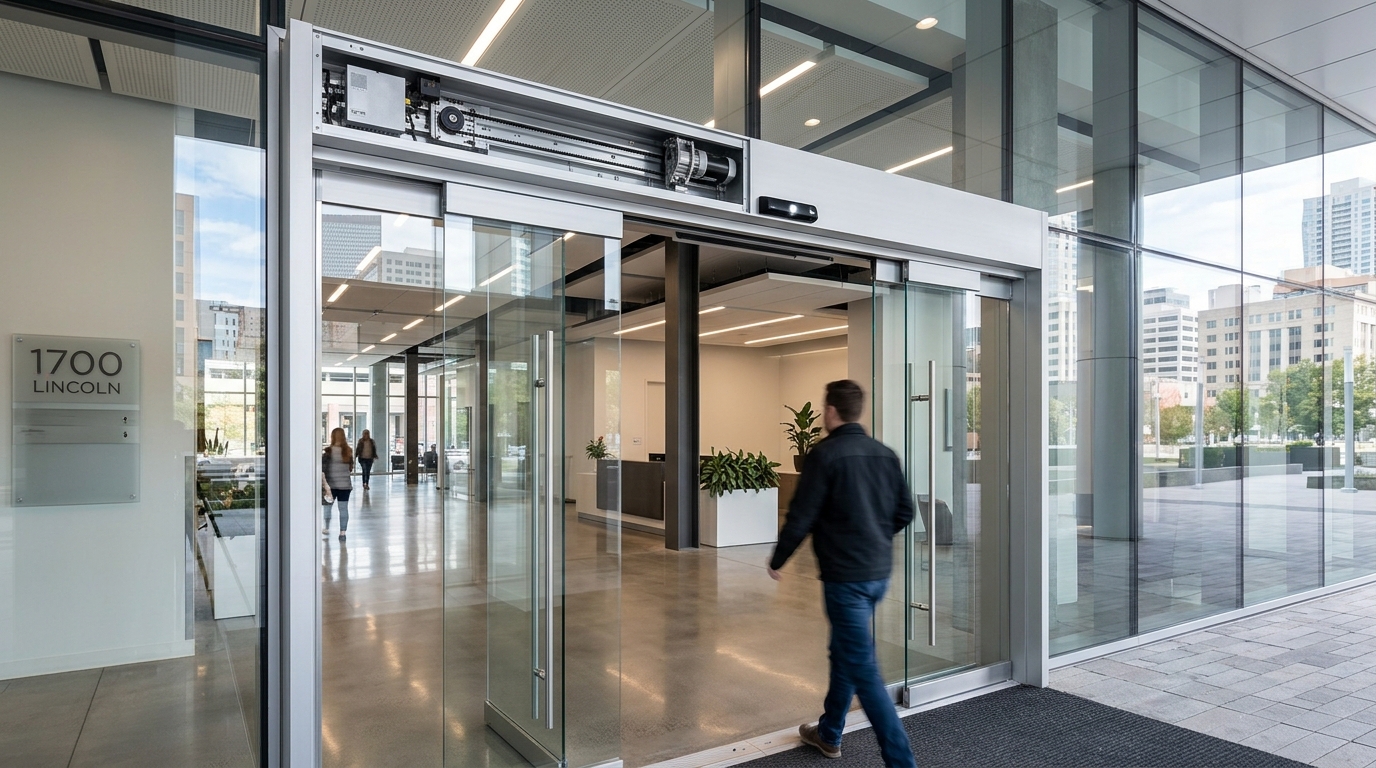
Sliding door operators use a track-and-trolley system mounted above the door opening. The door panels slide horizontally on the track to open and close. You see these most commonly at grocery stores, hospitals, and large retail locations.
Best for: High-traffic entrances where you need maximum throughput and energy efficiency. Because sliding doors don’t swing into the walkway, they eliminate the clearance issue entirely and create a wider effective opening.
Types of sliding operators:
- Single-slide: One panel slides to the side. Used when the opening is positioned against a wall.
- Bi-parting: Two panels slide apart from the center. This is the classic grocery store entrance configuration.
- Telescoping: Multiple panels stack behind each other when open, maximizing the clear opening width while minimizing the stacking space required on each side.
Key consideration: Sliding operators require wall space on one or both sides of the opening for the door panels to slide into. If your storefront doesn’t have that wall space, a swing operator or folding operator may be necessary.
3. Folding Door Operators
Folding door operators use hinged panels that fold against each other as they open, similar to an accordion. They are a niche solution for openings where neither a full swing nor a full slide is possible.
Best for: Extremely tight spaces, corner entrances, or retrofit applications where the existing architecture doesn’t support a swing or slide. We occasionally install these in older Denver buildings, particularly in LoDo and Capitol Hill, where the original architecture creates unusual entry configurations.
4. Revolving Door Operators
Revolving door operators are the premium solution for high-rise office buildings and large commercial properties. They continuously rotate, allowing a steady stream of people to enter and exit simultaneously while maintaining an air seal that dramatically reduces HVAC energy loss.
Best for: Class A office buildings, hotels, and convention centers. Denver’s extreme temperature swings - from sub-zero winter nights to 100-degree summer days - make revolving doors an excellent choice for energy-conscious property managers. The air seal alone can reduce HVAC costs by 30% compared to a standard swing entrance.
ADA Requirements for Automatic Doors in Colorado
This is where it gets critical. The Americans with Disabilities Act (ADA) has specific requirements for accessible entrances, and automatic door operators are one of the most effective ways to achieve compliance. If your building is required to have an accessible entrance - and virtually all commercial buildings in Colorado are - you need to understand the following:
Clear Opening Width
The ADA requires a minimum 32-inch clear opening when the door is open at 90 degrees. For automatic sliding doors, the full opening width must be at least 32 inches. Most commercial doors easily meet this requirement, but older buildings with non-standard door sizes may fall short.
Opening Force
This is the big one. The ADA sets strict limits on how much force is required to manually open an interior door:
- Interior doors: Maximum 5 pounds of force
- Fire doors: The minimum force allowed by the fire code authority
Many older buildings in Denver have doors that require 8, 10, or even 15 pounds of force to open - well above the ADA maximum. Installing an automatic operator is often the most practical solution to bring these doors into compliance without replacing the entire door assembly.
Timing and Speed
Automatic doors must remain open long enough for a person using a wheelchair, walker, or other mobility device to pass through safely. The ADA specifies that the door must take at least 5 seconds to move from the fully open position to a point where the clear opening is reduced to 12 inches.
Push-Plate Activators
If your automatic door is activated by a push plate (rather than a motion sensor), the push plate must be:
- Mounted at a height between 34 and 48 inches above the floor
- Located on an accessible route that can be reached from a wheelchair
- Operable with one hand and without tight grasping, pinching, or twisting
The Cost of Non-Compliance
ADA violations are not theoretical risks. The Department of Justice actively enforces ADA requirements, and Colorado has state-level accessibility mandates that go beyond the federal minimum in some cases. First-time ADA violations can result in fines of up to $75,000, and subsequent violations can reach $150,000. Beyond the fines, ADA lawsuits brought by private individuals can result in significant legal costs and settlements.
For a deeper dive into ADA compliance for commercial doors, see our comprehensive guide: The Ultimate Guide to ADA Compliance for Commercial Doors in Denver.
Sensor Technologies: How Automatic Doors Know When to Open
The sensor system is the brain of your automatic door operator. Different sensor technologies are suited for different applications:
Motion Sensors (Microwave)
Motion sensors use microwave technology to detect movement in a defined zone in front of the door. When someone walks into the detection zone, the door opens. These are the most common sensors on sliding doors at retail entrances.
Pros: Fast response, wide detection area, works in all weather conditions. Cons: Can be triggered by passing traffic, blowing debris, or animals. In windy Denver conditions, this can cause the door to cycle unnecessarily.
Presence Sensors (Infrared)
Presence sensors use infrared beams to detect when someone is standing in the door opening. They are typically used as safety sensors - preventing the door from closing on someone standing in the threshold - rather than as the primary activation sensor.
Pros: Excellent safety feature, very reliable. Cons: Limited detection range; not suitable as the sole activation method.
Push-Plate Activators
Push plates are large, easy-to-press buttons mounted on the wall near the door. They are the most common activation method for ADA-compliant swing door operators. The user presses the plate, and the door opens automatically.
Pros: Simple, reliable, ADA-compliant, and not affected by weather or environmental interference. Cons: Requires the user to physically reach and press the plate, which may not be possible for all users.
Touchless / Wave-to-Open Sensors
Post-pandemic, touchless activation has become extremely popular. These sensors detect a hand wave within a few inches of the sensor without requiring physical contact. They are increasingly standard in medical facilities, restaurants, and office buildings across Denver.
Pros: Hygienic, modern, ADA-compliant, and appealing to tenants and customers. Cons: Slightly higher cost than a standard push plate.
Colorado-Specific Installation Considerations
Installing automatic door operators in Colorado comes with unique challenges that don’t exist in other states.
Wind Load
Colorado’s Front Range is notorious for sudden, powerful wind gusts that can exceed 60 mph. An automatic door operator must be powerful enough to overcome wind resistance and close the door reliably even in extreme conditions. We always specify wind-rated operators for any exterior application along the Front Range, particularly for buildings in exposed locations like the Denver Tech Center, Interlocken, or the I-25 corridor.
Temperature Extremes
Automatic door operators contain electronic components and motors that must function reliably from well below zero to over 100°F. We install operators with cold-weather packages that include low-temperature lubricants and heated components to prevent freezing in Colorado’s brutal winters.
Altitude
At 5,280 feet and above, electric motors can behave differently due to reduced air density and cooling capacity. This isn’t a major concern for most modern operators, but it’s a factor we account for when specifying motors for high-cycle applications in Denver’s high-rise buildings.
Snow and Ice Clearance
For sliding door systems, snow and ice accumulation in the door track can prevent the panels from opening or cause them to jam. We install heated track systems and drainage solutions to prevent ice buildup at exterior sliding door installations throughout the Denver metro area.
Maintenance: Keeping Your Automatic Doors Running
Automatic door operators are mechanical systems with moving parts, and they require regular maintenance to operate safely and reliably. A neglected operator isn’t just an inconvenience - it’s a liability. If an automatic door malfunctions and injures someone, your business is exposed to significant legal risk.
Recommended Maintenance Schedule
| Task | Frequency |
|---|---|
| Visual inspection of sensors and activation devices | Monthly |
| Test safety sensors (presence detection) | Monthly |
| Lubricate moving parts (hinges, tracks, pivots) | Quarterly |
| Check and adjust opening/closing speed | Semi-annually |
| Full mechanical inspection by a certified technician | Annually |
| Replace batteries in backup power systems | Annually |
| Inspect and clean sensor lenses | Quarterly |
Signs Your Operator Needs Service
- The door hesitates or pauses during opening or closing
- The door doesn’t fully close or latch
- Unusual grinding, clicking, or humming noises from the operator
- The door opens or closes too quickly or too slowly
- The sensor activates inconsistently or has dead zones
- The push-plate activator requires multiple presses to work
- The door reverses direction mid-cycle
If you notice any of these symptoms, call us immediately. A small issue today can become a major repair - or a safety incident - tomorrow.
How Much Does an Automatic Door Operator Cost?
Cost varies significantly depending on the type of operator, the door configuration, and the complexity of the installation. Here’s a general range for Denver installations:
| Operator Type | Equipment Cost | Installed Cost |
|---|---|---|
| Swing door operator (retrofit) | $1,500–$3,500 | $2,500–$5,500 |
| Sliding door operator (bi-parting) | $4,000–$8,000 | $7,000–$14,000 |
| Folding door operator | $3,500–$7,000 | $6,000–$12,000 |
| Revolving door operator | $15,000–$40,000 | $25,000–$60,000+ |
These ranges include the operator unit, sensors, wiring, and professional installation. They do not include any structural modifications to the door frame, header, or electrical supply, which may be required in older buildings.
The ROI of Automatic Door Operators
While the upfront cost can seem significant, automatic door operators deliver measurable returns:
- ADA compliance eliminates exposure to fines and lawsuits
- Energy savings from reduced HVAC loss through open doors (especially with sliding and revolving operators)
- Reduced door hardware wear because the operator controls opening and closing forces precisely
- Improved customer experience and accessibility, which directly impacts foot traffic and revenue for retail businesses
Let Us Handle the Installation
At Denver Commercial Doors, we are the Front Range’s experts in automatic door operator systems. We handle every aspect of the process - from the initial site assessment and ADA compliance review to the installation, programming, and ongoing maintenance.
We install only commercial-grade operators from the industry’s most trusted manufacturers, and every installation is backed by our service guarantee. Whether you need a simple swing operator retrofit on a single office door or a complete sliding door entrance system for a major retail property, we have the expertise and the hardware to get it done right.
Ready to make your entrance accessible and automatic? Contact us today or call (303) 550-6252 for a free on-site assessment and quote.