
How to Choose the Right Commercial Door Closer for Your Denver Business
By Denver Commercial Doors
If you manage a commercial property in Denver, there is a small, unassuming piece of hardware on top of every door in your building that is quietly doing more work than almost anything else. The commercial door closer. It controls how the door opens, how fast it closes, and how much force is required to use it. When it works correctly, nobody notices it. When it fails, it can create a cascade of problems - from doors that slam violently to doors that won’t latch, leaving your building unsecured overnight.
Choosing the right commercial door closer isn’t as simple as grabbing one off a shelf. The size of the door, the weight, the wind exposure, the foot traffic, the fire rating, and even the altitude and temperature swings in Colorado all play a role in which closer is the right fit. Here is a comprehensive guide to help Denver business owners make the right choice.
Understanding Door Closer Sizes
Commercial door closers are categorized by “size,” which refers to the spring power inside the closer. The size determines how much force the closer can exert to close the door. The industry standard scale runs from Size 1 (lightest) to Size 6 (heaviest).
Here is a general breakdown:
- Size 1–2: Lightweight interior doors. Think of a small office door or an interior bathroom door that sees minimal traffic.
- Size 3: The most common size for standard interior commercial doors. Suitable for doors up to 36 inches wide in moderate traffic environments.
- Size 4: Heavier interior doors or standard exterior doors. This is the workhorse size for most Denver storefronts and office building entrances.
- Size 5–6: Heavy exterior doors, oversized doors, or doors exposed to extreme wind loads. If your building entrance faces west toward the mountains and catches those brutal Front Range wind gusts, you likely need a Size 5 or 6.
Why Size Matters in Colorado
At altitude, Denver’s air pressure is lower than at sea level, which can subtly affect building pressurization. When your HVAC system pressurizes the building, it creates a pressure differential against the exterior doors. This means an exterior door in Denver often requires more closing force than an identical door at sea level. Choosing a closer that is too small for your application will result in the door failing to latch - which is both a security risk and an energy waste disaster.
Types of Commercial Door Closers
There are three primary types of commercial door closers, and each has distinct advantages depending on your application.
1. Surface-Mounted Closers
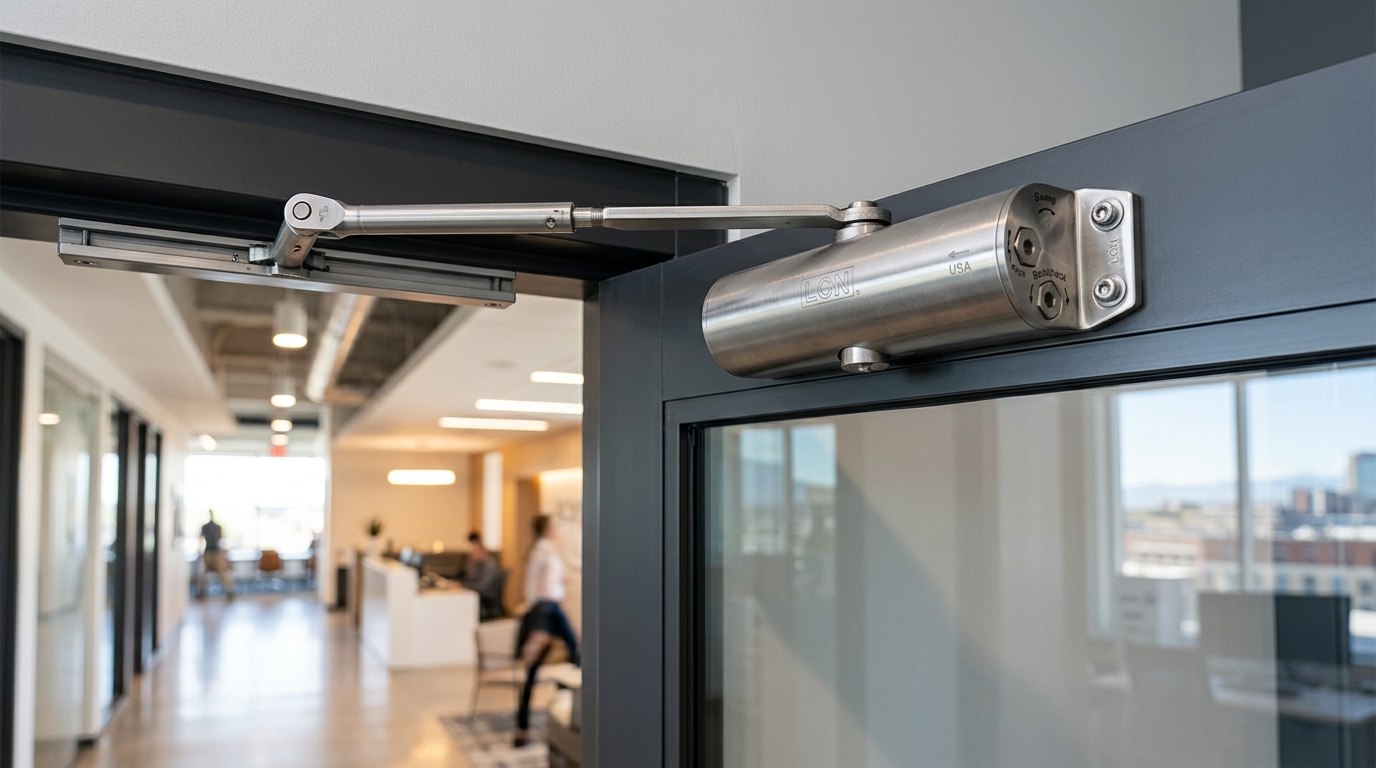
Surface-mounted closers are the most common type you’ll see in commercial buildings. They are installed on the face of the door or the frame and are fully visible. They are relatively easy to install, adjust, and replace.
Best for: Most standard commercial applications, including storefronts, offices, and retail spaces. If you need a straightforward, reliable, and budget-friendly solution, a surface-mounted closer is usually the answer.
Top brands we install: LCN, Norton, Dorma, and SARGENT.
2. Concealed Closers
Concealed closers are hidden inside the door or the frame, making them invisible when the door is closed. They provide a clean, modern aesthetic that is increasingly popular in upscale Denver office buildings and medical facilities.
Best for: High-end corporate lobbies, medical offices, and any application where aesthetics are a top priority. We frequently install concealed closers in buildings in the Denver Tech Center, Cherry Creek, and LoDo.
Trade-off: Concealed closers are significantly more expensive to purchase and install, and they are harder to service. If a concealed closer fails, the repair is more invasive than simply swapping out a surface-mounted unit.
3. Floor Closers (Floor Springs)
Floor closers are embedded into the floor beneath the door. They are most commonly used on heavy glass doors, such as the full-height frameless glass doors you see in high-end retail stores and hotel lobbies.
Best for: Heavy glass doors, pivot doors, and applications where both the door and the frame need to remain completely clean of hardware. We install floor closers in many of Denver’s premium retail and hospitality spaces.
Trade-off: Installation requires cutting into the concrete floor, which makes floor closers the most expensive and complex option. They are also susceptible to water damage if the building floods or if snowmelt seeps under the threshold - a real concern during Colorado’s spring runoff season.
Critical Adjustments Every Closer Needs
A door closer straight out of the box is not ready to install. Every closer must be fine-tuned to the specific door, location, and traffic pattern. Here are the four critical adjustments:
Sweep Speed
Sweep speed controls how fast the door moves from the fully open position (typically 90 degrees) to about 15 degrees from the frame. This is the main “closing speed” of the door. Too fast, and the door slams dangerously. Too slow, and the door hangs open, wasting energy and compromising security.
Latch Speed
Latch speed controls the final few degrees of closing - the last push that drives the latch bolt into the strike plate. This speed needs to be fast enough to ensure the door latches securely, but not so aggressive that it slams the door shut in someone’s face.
Backcheck
Backcheck is a critically important feature that most property managers overlook. It controls the resistance when the door is opened past a certain point (usually around 75 degrees). On a windy Denver day, a door without proper backcheck can be caught by a gust and thrown violently open, shattering the glass, ripping the hinges off the frame, or injuring someone standing nearby.
If your building’s entrance faces west or north and is exposed to wind, backcheck is non-negotiable. We strongly recommend heavy-duty backcheck on every exterior closer we install along the Front Range.
Delayed Action (Hold-Open)
Some closers offer a delayed action feature that holds the door open for a set period (typically 10–60 seconds) before the closing cycle begins. This is extremely useful for:
- ADA compliance: Allowing wheelchair users, people with walkers, or anyone carrying heavy items enough time to pass through without the door closing on them.
- High-traffic entrances: Preventing the closer from constantly cycling during peak hours, which dramatically extends the life of the closer.
- Loading docks and delivery entrances: Where workers need the door to stay open while they carry materials through.
The Colorado Climate Factor
We cannot stress this enough: Colorado’s extreme temperature swings wreak havoc on door closers. The hydraulic fluid inside a door closer thickens in cold weather and thins in heat. This means a closer that is perfectly adjusted in July will behave completely differently in January.
Here’s what happens:
- In winter (below 20°F): The hydraulic fluid thickens, causing the door to close much more slowly. It may not even latch. This leaves your building unsecured and lets freezing air pour inside, spiking your heating bills.
- In summer (above 90°F): The fluid thins, causing the door to close faster and harder. This can result in the door slamming shut, which is a safety hazard and accelerates wear on the closer, hinges, and frame.
Our Recommendation
We recommend that Denver business owners have their door closers professionally adjusted at least twice per year - once before winter and once before summer. This simple seasonal maintenance can extend the life of a closer by 3–5 years and prevent costly emergency repairs.
When to Replace vs. Repair
Door closers are not designed to last forever. A high-quality commercial closer, properly maintained, will typically last 8–15 years depending on traffic volume. Here are the signs it’s time for a replacement:
- Oil leaking from the closer body: This is the most obvious sign of failure. Once the hydraulic fluid leaks out, the closer loses all ability to control the door. It cannot be refilled - the unit must be replaced.
- The door slams shut or won’t latch: If adjusting the valves no longer solves the problem, the internal seals have likely failed.
- The closer arm is bent or broken: This usually happens from wind damage, abuse, or someone propping the door open by wedging an object against the arm. A bent arm puts enormous stress on the closer body and will lead to premature failure.
- Excessive noise: Grinding, squealing, or clicking sounds indicate internal wear.
Choosing the Right Closer for Your Business
Here’s a quick reference guide based on common Denver business types:
| Business Type | Recommended Closer Size | Key Features |
|---|---|---|
| Small retail shop | Size 3–4 | Backcheck, ADA-compliant sweep |
| Office building entrance | Size 4–5 | Heavy-duty backcheck, delayed action |
| Restaurant / café | Size 3–4 | Delayed action for high traffic |
| Medical facility | Size 4 | Concealed, ADA-compliant, delayed action |
| Warehouse / industrial | Size 5–6 | Maximum wind resistance, heavy-duty arm |
| School / public building | Size 4–5 | Fire-rated, ADA-compliant, vandal-resistant |
Let the Experts Handle It
Selecting and installing the right door closer involves far more variables than most people realize. An undersized closer will fail prematurely. An oversized closer will make the door too difficult to open, creating an ADA violation. And an improperly installed closer can void the fire rating of a fire-rated door assembly - a serious code violation that can result in fines and liability.
At Denver Commercial Doors, we assess every door individually. We consider the door size, weight, traffic volume, wind exposure, fire rating, and ADA requirements before recommending a closer. We install only commercial-grade hardware from trusted manufacturers and back every installation with our service guarantee.
Don’t let a failing door closer compromise your building’s security or accessibility. Contact us today for a professional assessment and get the right closer installed the first time.