
Panic Bars & Exit Devices: What Colorado Fire Code Requires for Your Business
By Denver Commercial Doors
You push on them every day without a second thought. Panic bars, also called crash bars, push bars, or exit devices, are on the doors of almost every restaurant, gym, church, school, and retail store in Denver. They are also one of the most important life-safety devices in your building, and one of the most common reasons a business gets written up by the fire marshal.
Whether you are opening a new location, remodeling, or trying to add a keypad lock to your front door, it pays to understand how panic hardware works and what the code expects. At Denver Commercial Doors, we install, repair, and replace exit devices for businesses across the Front Range. Here is what you need to know.
What Is a Panic Bar?
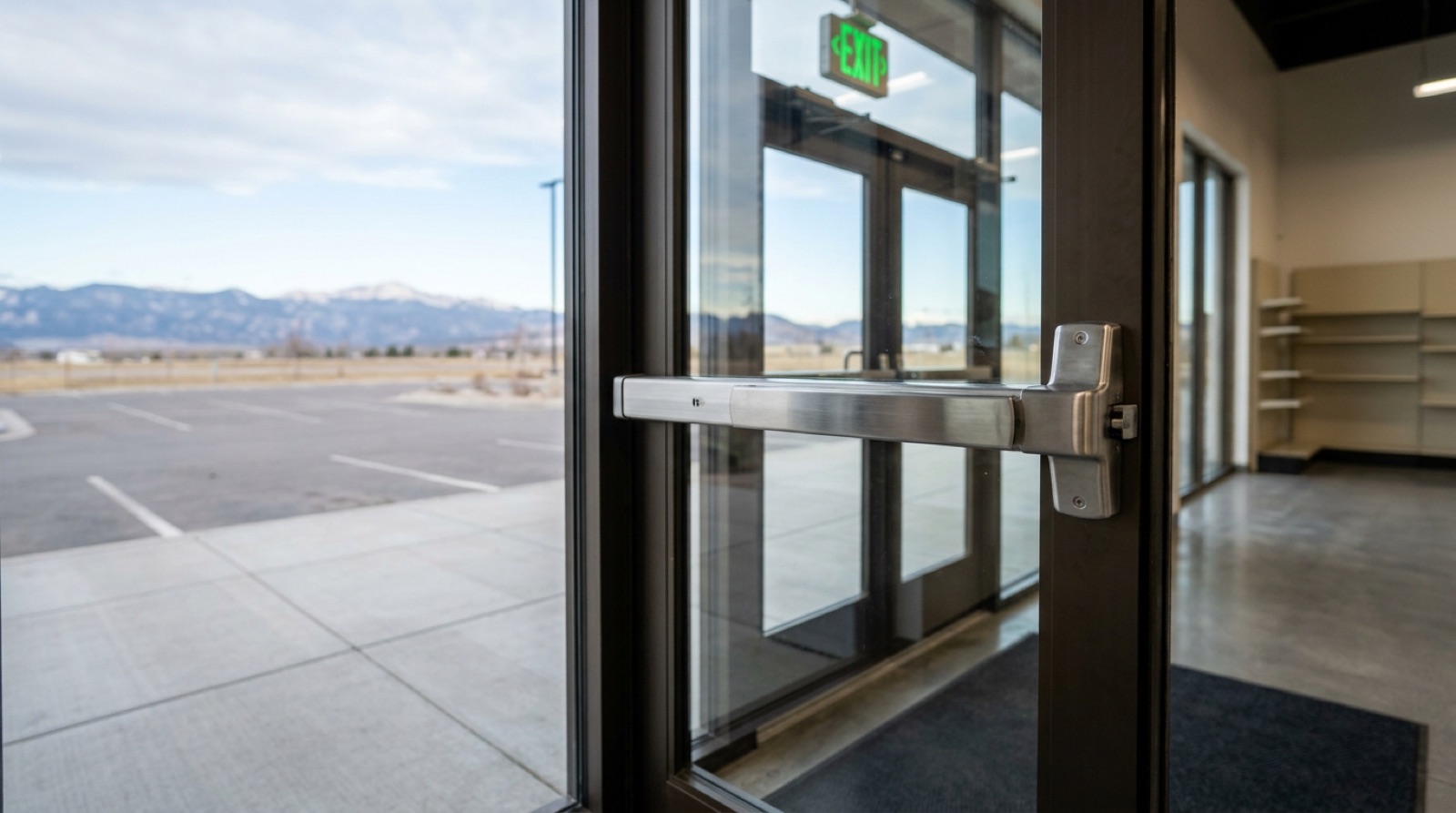
A panic bar is a horizontal bar or touchpad across the inside of a door. Pushing anywhere on the bar unlatches the door instantly, so people can get out in a single motion, even in a crowd, in the dark, or in a panic. No turning a knob, no finding a key, no special knowledge required.
There are two main categories:
- Panic hardware is used on standard (non-fire-rated) exit doors.
- Fire exit hardware is used on fire-rated doors. It is tested and labeled for fire use, and it cannot be “dogged” (held in the unlatched position), because a fire door must latch every time it closes.
When Does Colorado Fire Code Require Panic Hardware?
Denver and most Colorado cities adopt the International Building Code and International Fire Code, sometimes with local amendments. In general, panic or fire exit hardware is required on exit doors that are latched or locked in:
- Assembly spaces with 50 or more occupants, such as restaurants, bars, churches, gyms, theaters, and event venues
- Educational buildings with 50 or more occupants, including schools and many daycares
- High-hazard spaces where hazardous materials are stored or used
- Certain electrical rooms that contain large electrical equipment
Even when panic hardware is not strictly required, every exit door must open from the inside without a key, tool, or special knowledge. That means double-cylinder deadbolts, slide bolts, and padlocks on exit doors are usually a violation. Your local fire marshal has the final say on your specific building.
Tip: If your occupant load is close to 50, or you plan to host events, ask about panic hardware before you open. Retrofitting after a failed inspection is more expensive and disruptive.
The Main Types of Exit Devices
1. Rim Exit Devices
The most common type. The latch is mounted on the face of the door and catches a strike on the frame.
- Best for: Single hollow metal doors, back doors, and many interior exit doors.
- Pros: Simple, durable, and the most affordable option.
2. Narrow Stile Exit Devices
Built specifically for aluminum storefront doors, where the door frame is only a few inches wide.
- Best for: Glass storefront entrances found in most Denver retail centers and offices.
- Pros: Fits narrow aluminum doors without major modification. See our aluminum storefronts and glass services.
3. Vertical Rod Exit Devices
Rods run to the top (and sometimes the bottom) of the door to latch into the frame and floor. They can be surface mounted or concealed inside the door.
- Best for: Pairs of doors without a center post, such as double entry doors and gymnasium doors.
- Cons: More moving parts, and bottom rods can wear out or drag in high-traffic or snowy entries.
4. Mortise Exit Devices
The latch sits inside a pocket in the edge of the door for a heavy-duty, secure installation.
- Best for: High-security or very high-traffic doors in schools, hospitals, and institutional buildings.
Why Your Crash Bar Might Not Work With a Keypad
This is one of the most common calls we get. A business owner buys a keypad lock, or wants keyless entry on the front door, and finds out the existing panic bar does not support it.
Here is why:
- Exterior trim has to match the device. A keypad mounts as outside trim that controls the panic bar’s latch. It has to be built for that specific brand and model of exit device, such as Von Duprin, Precision, Detex, Jackson, or Adams Rite.
- Some devices are “exit only.” Many older or budget panic bars were never designed to accept outside trim at all.
- Narrow stile doors are especially picky. Storefront exit devices often use a cylinder and tailpiece that must line up exactly with the keypad.
- Worn devices are not worth adapting. If the panic bar is old, sticking, or missing parts, putting a new keypad on it rarely makes sense.
In many cases, the smartest and most cost-effective option is to replace the exit device and install a matching keypad at the same time. That way every part is designed to work together, and you get a warranty on the whole system. Learn more about your options in our guide to keypad and keyless entry locks.
And no matter what kind of lock you add, the panic bar must still let anyone exit instantly from the inside. A properly installed keypad controls who gets in, never who gets out.
Common Panic Bar Problems
- Door won’t latch after it closes, which leaves your business unsecured overnight
- Bar is hard to push or sticks, especially in cold weather
- Dogging no longer holds the bar down during business hours
- Vertical rods out of adjustment so one leaf of a pair won’t latch
- Loose or damaged devices from heavy daily use or forced entry
- Chains or padlocks added to exit doors for security, which is a serious fire code violation
Most of these are quick fixes for an experienced technician. Our commercial door repair team adjusts, repairs, and replaces exit devices every week.
How Much Does a Panic Bar Cost in Denver?
Here are typical installed price ranges in the Denver Metro area:
| Exit Device Option | Typical Installed Cost Range |
|---|---|
| Panic bar repair or adjustment | $150 to $400 |
| Rim exit device, installed | $450 to $900 |
| Narrow stile storefront exit device, installed | $600 to $1,100 |
| Fire-rated exit device, installed | $700 to $1,400 |
| Vertical rod exit device, installed | $900 to $1,800 |
| New exit device with keypad trim, installed | $1,800 to $2,600 |
Note: These are general estimates for planning purposes. Your price depends on your door type, the brand and function you need, and your existing hardware. Request a free estimate for an accurate quote.
Don’t Forget Fire Doors and ADA
- Fire-rated doors need labeled fire exit hardware, and the device must latch every time the door closes. Learn more in our guide to fire-rated doors and annual inspections.
- ADA accessibility requires hardware that operates without tight grasping, pinching, or twisting, mounted at an accessible height. Panic bars generally meet this requirement when installed correctly. See our guide to ADA compliance for commercial doors.
Signs It’s Time to Repair or Replace Your Exit Device
- Your door does not latch reliably when it closes
- The bar is sticking, loose, or hard to push
- You want to add a keypad or access control
- The fire marshal or your insurance carrier flagged your exit doors
- Your occupancy or use has changed, such as adding seating or events
Get a Fast Quote, Often From Photos
In many cases, we can identify your exit device and quote a repair or replacement from just a few photos. Send us a picture of the whole door, the panic bar, and the label on the device if you can find one.
Denver Commercial Doors installs and repairs panic bars and exit devices for businesses throughout Denver, Aurora, Lakewood, Arvada, Westminster, Broomfield, Centennial, and the rest of the Front Range. Our door hardware and security team will make sure your doors are secure on the outside and code compliant on the inside.
Need a panic bar installed, repaired, or paired with a keypad? Contact Denver Commercial Doors today or call (303) 550-6252. We will recommend the right exit device for your door, your business, and your budget.